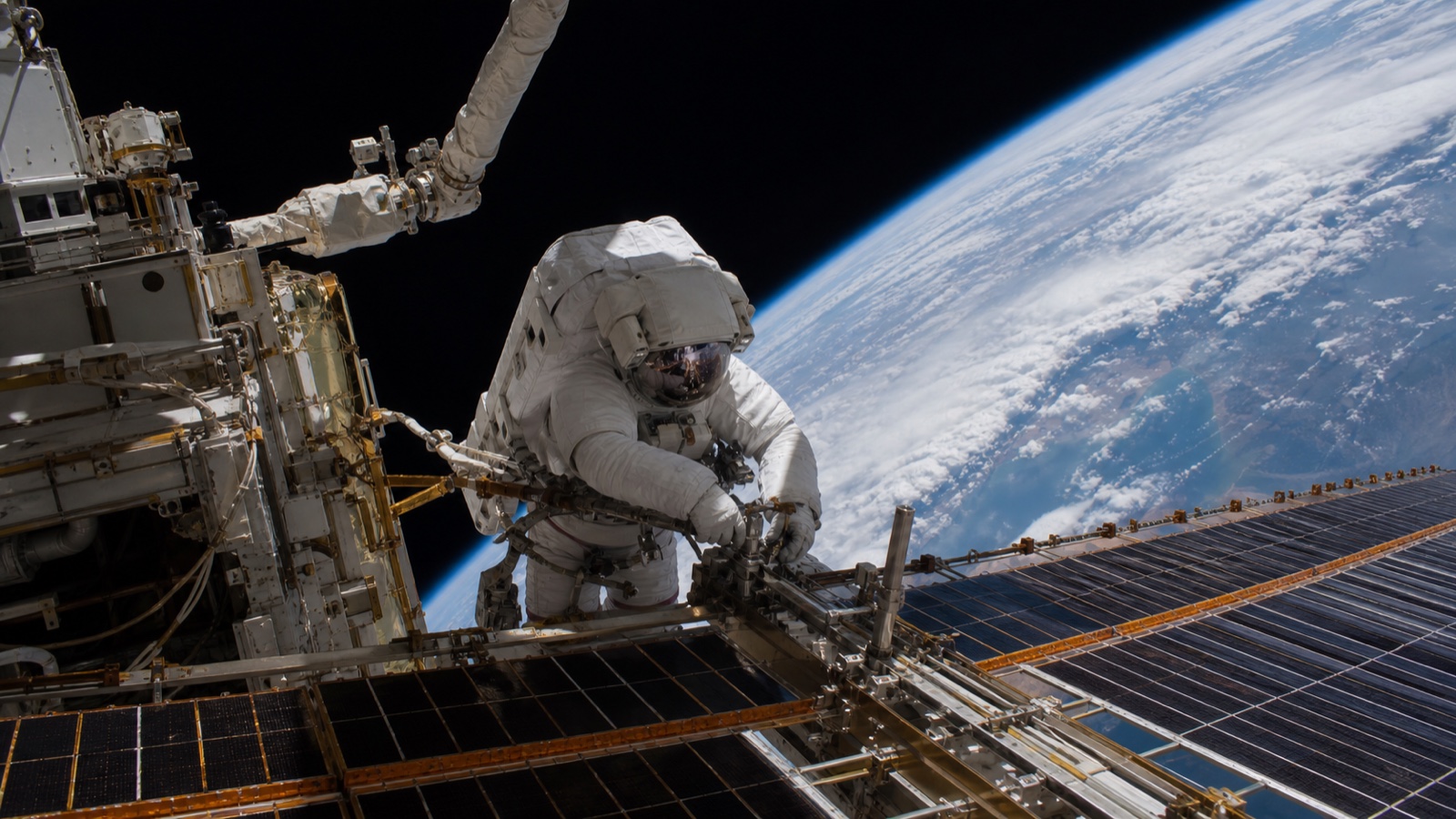
NASA plans three U.S. spacewalks on August 6, 13 and 25 to service power, communications, docking and future deorbit systems on the International Space Station.
Key facts
- Three spacewalks are planned for August
- The first is expected to last about 6.5 hours
- The missions would be the 281st through 283rd spacewalks supporting station assembly and maintenance
Timeline
August 6 — U.S. spacewalk 96 is scheduled for power-channel and solar-array preparation. August 13 — Spacewalk 97 is planned for antenna work. August 25 — Spacewalk 98 is planned for power, data, deorbit and docking-navigation tasks.
The station depends on maintenance that is rarely visible in broad mission headlines. Power, radio links and navigation aids are the systems that keep a permanently crewed laboratory usable, while deorbit preparations acknowledge that the station’s operating life is finite.
The schedule is a reminder that orbital infrastructure requires recurring maintenance, training and replacement hardware after launch. The economic story of space is operations as much as access to orbit.
What happened?
Jessica Meir and Anil Menon are assigned to the first excursion, which is expected to begin at 8:35 a.m. EDT and last about six and a half hours. NASA says the crew will modify the 3B power channel and prepare for a future roll-out solar array. Later spacewalks are planned to replace a space-to-ground antenna and connect power and data hardware.
Why it matters
The station depends on maintenance that is rarely visible in broad mission headlines. Power, radio links and navigation aids are the systems that keep a permanently crewed laboratory usable, while deorbit preparations acknowledge that the station’s operating life is finite.
Background
NASA plans three U.S. spacewalks on August 6, 13 and 25 to service power, communications, docking and future deorbit systems on the International Space Station.
What each side says
NASA describes the work as planned station maintenance and upgrades. The agency also makes clear through its scheduling language that timing and task lists remain subject to operational changes.
What happens next
NASA will provide live coverage and can revise start times or assignments. Completion should be judged from post-spacewalk updates rather than the preview schedule.
Nivegu analysis
The three excursions form a compact map of station priorities: maintain today’s electrical and communications systems, support visiting vehicles, and prepare responsibly for the eventual end of the platform.
Different viewpoints
Station research and future crews benefit when aging systems are serviced before a failure. The solar-array preparation also supports a broader effort to preserve usable power as original arrays degrade.
Spacewalks carry operational risk and can be delayed by hardware, crew readiness or station conditions. A published date is a plan, not proof that the work has been completed.
What are you still wondering?
Answers will use this briefing and its cited sources.Sources and further reading
01NASA — August spacewalk preview↗02NASA — International Space Station↗Questions, answered.
What is the short version?
NASA plans three U.S. spacewalks on August 6, 13 and 25 to service power, communications, docking and future deorbit systems on the International Space Station.
Why does this matter now?
The station depends on maintenance that is rarely visible in broad mission headlines. Power, radio links and navigation aids are the systems that keep a permanently crewed laboratory usable, while deorbit preparations acknowledge that the station’s operating life is finite.
What should readers watch next?
The schedule is a reminder that orbital infrastructure requires recurring maintenance, training and replacement hardware after launch. The economic story of space is operations as much as access to orbit.