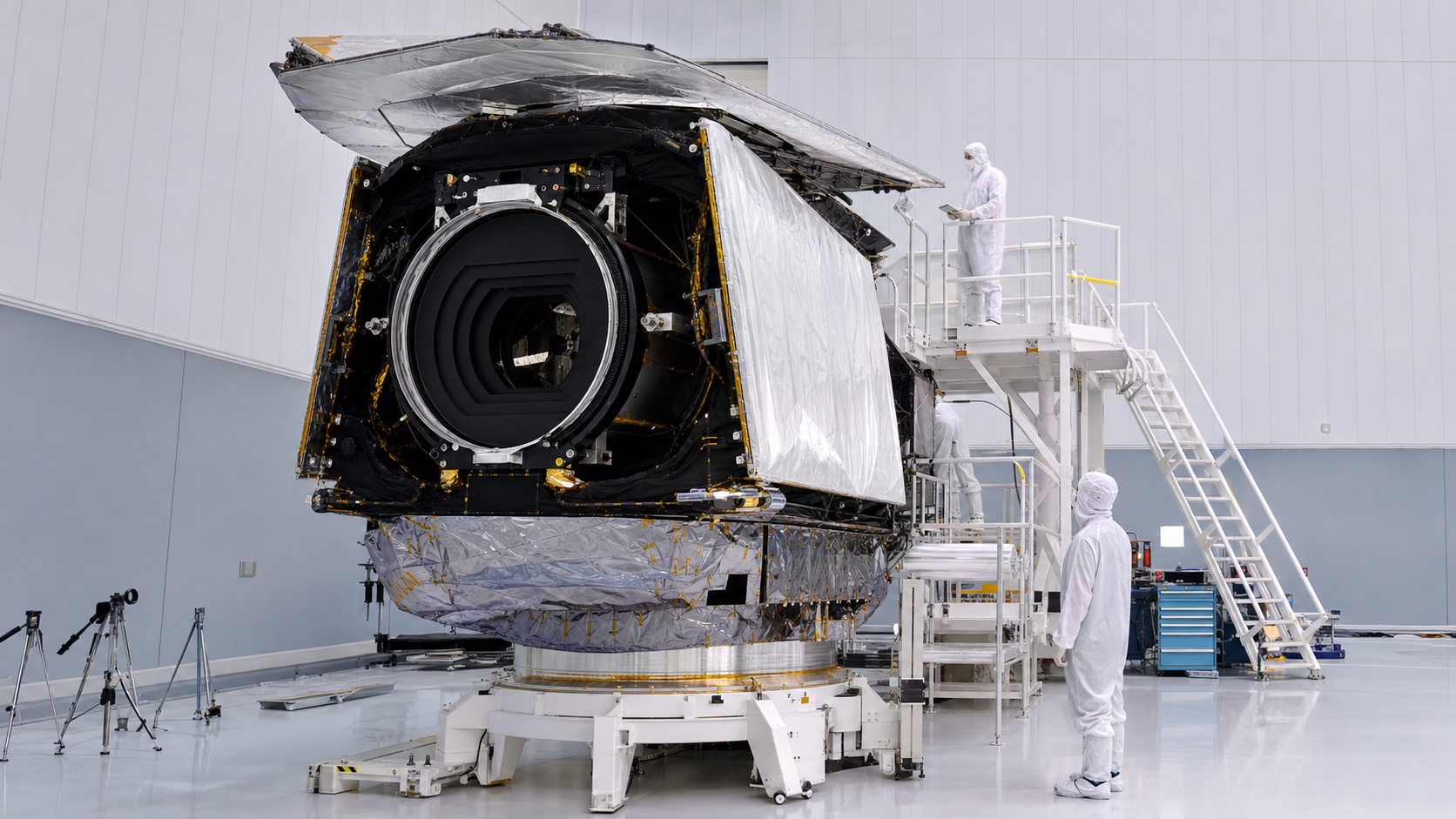
NASA is preparing the Nancy Grace Roman Space Telescope for an August 30 launch aboard a SpaceX Falcon Heavy. Roman’s defining advantage is coverage: NASA says its field of view is at least 100 times larger than Hubble’s, allowing it to survey large regions of the universe while retaining Hubble-class sharpness.
Key facts
- NASA launch target: August 30, 2026
- Launch vehicle: SpaceX Falcon Heavy
- Primary advantage: a field of view at least 100 times larger than Hubble’s
Timeline
July 21, 2026 — NASA announced an August media briefing for the mission. August 2026 — Roman entered its scheduled launch month. August 30, 2026 — NASA’s published launch target is 7:20 a.m. EDT from Kennedy Space Center’s Launch Complex 39A.
Roman is not simply another telescope with a larger mirror. Its value comes from combining sharp images with a wide field, which changes how quickly astronomers can build statistically useful catalogs of galaxies, stars and planetary systems.
The mission will also test the industrial coordination behind a flagship observatory: launch services, spacecraft operations, data pipelines and long-term archives all have to work together before the science return arrives.
What happened?
NASA scheduled a pre-launch media briefing as the mission entered its final month. The observatory is intended to study dark energy, map matter across cosmic time and conduct a broad search for exoplanets using both microlensing and direct-imaging technology demonstrations.
Why it matters
Roman is not simply another telescope with a larger mirror. Its value comes from combining sharp images with a wide field, which changes how quickly astronomers can build statistically useful catalogs of galaxies, stars and planetary systems.
Background
NASA is preparing the Nancy Grace Roman Space Telescope for an August 30 launch aboard a SpaceX Falcon Heavy. Roman’s defining advantage is coverage: NASA says its field of view is at least 100 times larger than Hubble’s, allowing it to survey large regions of the universe while retaining Hubble-class sharpness.
What each side says
NASA presents Roman as a complementary successor to existing observatories, not a replacement for Hubble or Webb. Mission planners emphasize survey scale; scientists will still need narrower, deeper observations from other facilities to investigate individual objects in detail.
What happens next
The immediate milestones are launch readiness, the August 30 launch window and spacecraft commissioning. Science operations depend on those steps succeeding; Nivegu will update this page if NASA changes the schedule or publishes new readiness information.
Nivegu analysis
Roman’s real comparison with Hubble is not a beauty contest between individual images. It is throughput. The mission is built to turn wide areas of sky into repeatable, searchable evidence at a scale that changes which questions can be asked.
Different viewpoints
Researchers studying large populations rather than isolated targets stand to gain most. Roman’s public survey data can also give smaller teams access to observations that would be difficult to assemble project by project.
A launch date is not a science result. Schedule, commissioning and instrument performance still have to be demonstrated before the mission can deliver the surveys described in its plans.
What are you still wondering?
Answers will use this briefing and its cited sources.Sources and further reading
01NASA — Roman Space Telescope mission↗02NASA — Roman launch media briefing↗Questions, answered.
What is the short version?
NASA is preparing the Nancy Grace Roman Space Telescope for an August 30 launch aboard a SpaceX Falcon Heavy. Roman’s defining advantage is coverage: NASA says its field of view is at least 100 times larger than Hubble’s, allowing it to survey large regions of the universe while retaining Hubble-class sharpness.
Why does this matter now?
Roman is not simply another telescope with a larger mirror. Its value comes from combining sharp images with a wide field, which changes how quickly astronomers can build statistically useful catalogs of galaxies, stars and planetary systems.
What should readers watch next?
The mission will also test the industrial coordination behind a flagship observatory: launch services, spacecraft operations, data pipelines and long-term archives all have to work together before the science return arrives.