Australia’s transport safety investigator said a Qantas Airbus A380, registration VH-OQK, completed flights from Sydney to Dallas–Fort Worth and back with a portable work light inside its left wing. The final report found several missed opportunities to detect the unreturned tool before the aircraft was released to service. No structural damage, system disruption or other adverse consequence was found.
Key facts
- Aircraft: Airbus A380-842, registration VH-OQK
- Flights completed with the light aboard: two sectors
- Route: Sydney–Dallas–Fort Worth–Sydney
- Outcome: no structural damage, system disruption or other adverse consequence
- Report release: Aug. 17, 2026
Timeline
Jan. 7 — maintenance is performed inside VH-OQK’s left wing in Sydney; the light remains behind and the aircraft departs for Dallas–Fort Worth. Jan. 8 — the A380 leaves Dallas on the return sector. Jan. 9 — a tool-crib review identifies the missing light and a search finds it inside the wing; investigators report no damage or system disruption. Aug. 17 — the ATSB releases its final report and findings.
Foreign objects left in aircraft can damage structures or systems, even when a particular occurrence ends without harm. The report’s central lesson is systemic: a barcode record existed, but the maintenance information system did not automatically warn the certifying engineer that a tool remained unreturned or that the tool report had not been reviewed.
The report does not quantify a financial impact, fleet restriction or regulatory penalty. Any claim about Qantas earnings, Airbus orders or A380 operations would go beyond the published evidence. The immediate signal is operational and procedural, not a disclosed market event.
What happened?
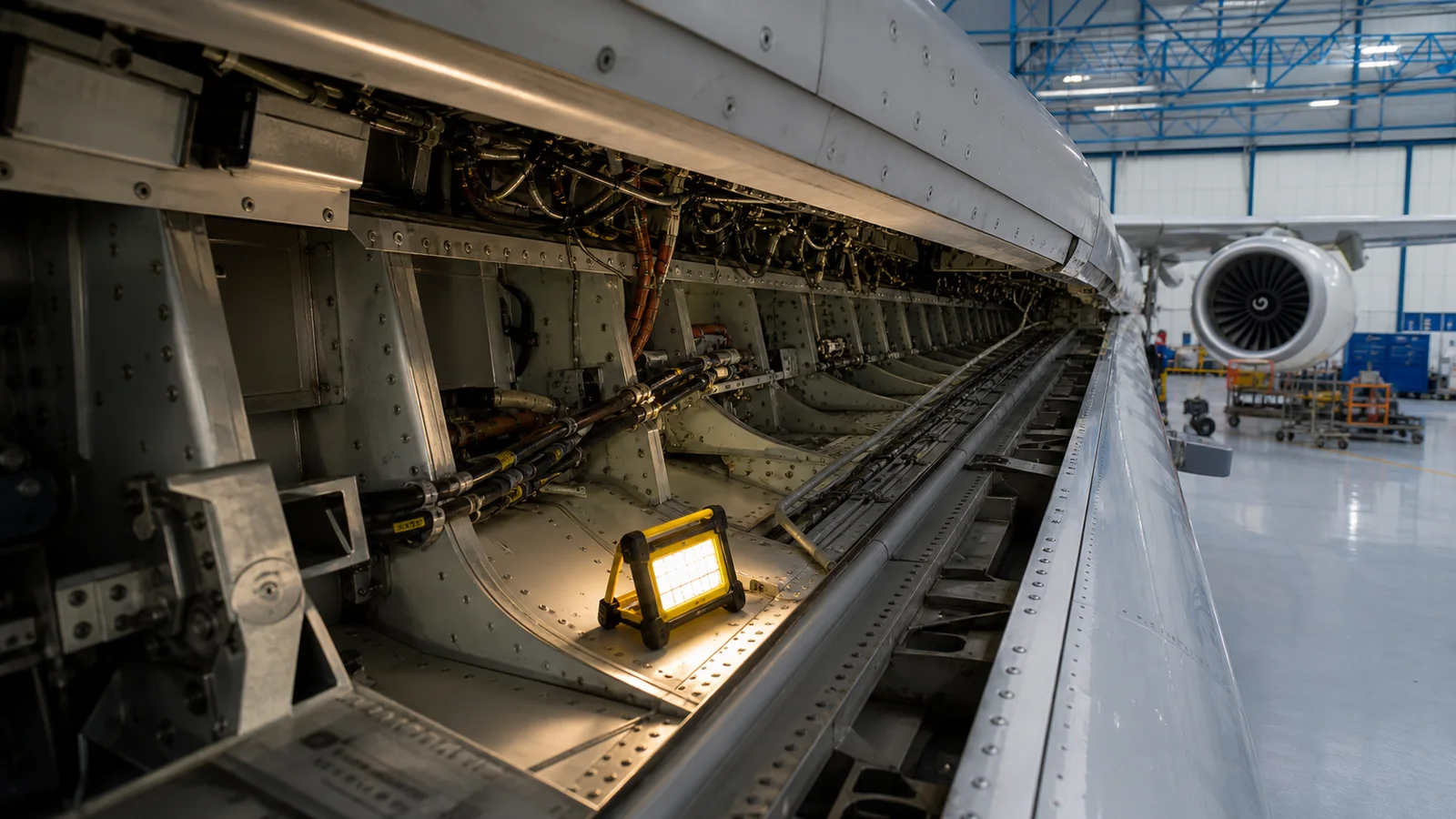
Maintenance workers used the light while replacing an air-conditioning-system temperature sensor inside the left wing at Sydney Airport on Jan. 7. The light was switched off and remained in the confined workspace. It was missed during foreign-object inspections, was not identified as absent when tools were returned, and did not stop the certificate of release to service. The aircraft then flew QF7 to Dallas–Fort Worth and QF8 back to Sydney. A tool-crib review on Jan. 9 triggered the search that located the light.
Why it matters
Foreign objects left in aircraft can damage structures or systems, even when a particular occurrence ends without harm. The report’s central lesson is systemic: a barcode record existed, but the maintenance information system did not automatically warn the certifying engineer that a tool remained unreturned or that the tool report had not been reviewed.
Background
Australia’s transport safety investigator said a Qantas Airbus A380, registration VH-OQK, completed flights from Sydney to Dallas–Fort Worth and back with a portable work light inside its left wing. The final report found several missed opportunities to detect the unreturned tool before the aircraft was released to service. No structural damage, system disruption or other adverse consequence was found.
What each side says
The Australian Transport Safety Bureau said the occurrence resulted from a breakdown in foreign-object control and tool-accountability processes and emphasized that established procedures remain vulnerable when they rely only on consistent human performance. Qantas told the investigator it had issued a safety directive, created a tooling working group and was pursuing changes including technology intended to improve tool control. The report records those actions; it does not say the airline intentionally released the aircraft with a known object in the wing.
What happens next
Qantas is expected to continue the tool-control initiatives described to the investigator. The practical checkpoint is whether its maintenance information system gains a reliable prompt or release-blocking control for unreturned tools. Regulators and other operators can also compare their own certification workflows against the ATSB’s findings.
Nivegu analysis
The most important fact is not that one person forgot a light. The failure crossed several layers: the visual inspection, tool return, end-of-shift review and release certification. The ATSB identified the absence of an automated alert as a safety issue because the system allowed every manual omission to line up. Qantas’s response therefore matters most where it changes the release workflow, not where it merely repeats the instruction to account for tools.
Different viewpoints
Passengers and crew avoided harm, and the investigation produced a specific control problem that can be corrected. Maintenance teams benefit when software turns a missing-tool record into a hard operational warning rather than leaving detection to memory and manual checks.
Qantas’s maintenance controls face renewed scrutiny because this was another A380 tool-accountability event. The report also shows the limits of procedures that appear complete on paper but can still permit an aircraft release when several human checks fail in sequence.
What are you still wondering?
Answers will use this briefing and its cited sources.Sources and further reading
01ATSB — Foreign object debris involving Airbus A380 VH-OQK↗02Aerospace Global News — Qantas A380 flew with tool in wing↗03ATSB — Previous A380 tool-control final report AO-2024-006↗Questions, answered.
What is the short version?
Australia’s transport safety investigator said a Qantas Airbus A380, registration VH-OQK, completed flights from Sydney to Dallas–Fort Worth and back with a portable work light inside its left wing. The final report found several missed opportunities to detect the unreturned tool before the aircraft was released to service. No structural damage, system disruption or other adverse consequence was found.
Why does this matter now?
Foreign objects left in aircraft can damage structures or systems, even when a particular occurrence ends without harm. The report’s central lesson is systemic: a barcode record existed, but the maintenance information system did not automatically warn the certifying engineer that a tool remained unreturned or that the tool report had not been reviewed.
What should readers watch next?
The report does not quantify a financial impact, fleet restriction or regulatory penalty. Any claim about Qantas earnings, Airbus orders or A380 operations would go beyond the published evidence. The immediate signal is operational and procedural, not a disclosed market event.