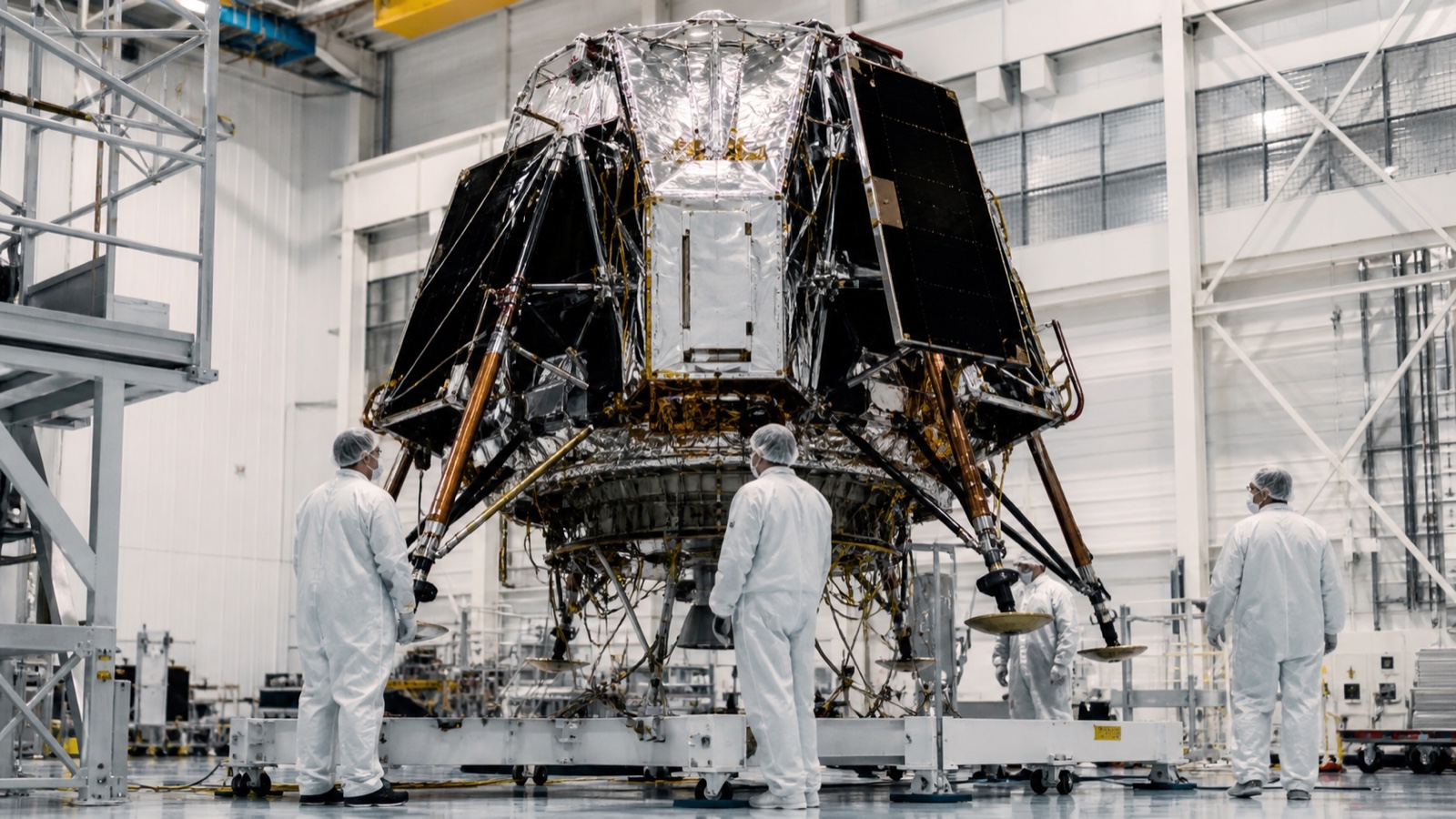
NASA says Blue Origin, Firefly Aerospace, Intuitive Machines and Voyager Space are advancing lunar cargo missions within its Moon Base and Commercial Lunar Payload Services plans, with larger deliveries targeted before the end of the decade.
Key facts
- Four commercial teams are named in NASA’s cargo update
- NASA says deliveries supporting the Moon Base effort are targeted by 2028
- The plan combines transportation with power, avionics and lunar-night demonstrations
Timeline
2026 — NASA published updates on cargo landers and technology demonstrations. Late 2026 — Voyager’s Griffin-1 is listed with a planned launch target. Through 2029 — NASA’s first Moon Base phase calls for more than 20 robotic landings.
A sustained lunar program needs more than crew vehicles. Cargo capacity, communications, power and thermal survival determine whether equipment arrives, operates and remains useful between missions.
The opportunity extends beyond landers to propulsion, communications, power, thermal control and mission operations. NASA’s program creates demand signals, but an agency update is not the same as a completed delivery or guaranteed revenue.
What happened?
An agency update described testing and preparation across several landers: Blue Moon Mark 1, Firefly’s Blue Ghost program, Intuitive Machines’ IM-3 mission and Voyager’s Griffin-1. NASA also outlined technology demonstrations for surface power, avionics and surviving the lunar night.
Why it matters
A sustained lunar program needs more than crew vehicles. Cargo capacity, communications, power and thermal survival determine whether equipment arrives, operates and remains useful between missions.
Background
NASA says Blue Origin, Firefly Aerospace, Intuitive Machines and Voyager Space are advancing lunar cargo missions within its Moon Base and Commercial Lunar Payload Services plans, with larger deliveries targeted before the end of the decade.
What each side says
NASA presents commercial deliveries as a way to increase cadence and build capability. The update also depends partly on contractor progress reports, so each milestone should be separated from independent proof of mission success.
What happens next
Watch for integrated tests, launch-readiness decisions and actual mission results. NASA says the first phase of its Moon Base plan includes more than 20 robotic landings through 2029, but individual dates remain subject to change.
Nivegu analysis
The durable lunar-economy question is logistics. A base becomes credible only when cargo missions can repeat, interfaces become predictable and surface systems survive the environment. The current work is infrastructure validation, not a finished supply chain.
Different viewpoints
Companies that can demonstrate reliable delivery and surface operations gain evidence for later missions. Scientists benefit if commercial landers create more frequent access for instruments.
Schedules and company-reported milestones can slip. Hardware that passes one test has not yet proved launch, landing or long-duration lunar performance.
What are you still wondering?
Answers will use this briefing and its cited sources.Sources and further reading
01NASA — Moon Base cargo lander update↗02NASA — Commercial Lunar Payload Services↗Questions, answered.
What is the short version?
NASA says Blue Origin, Firefly Aerospace, Intuitive Machines and Voyager Space are advancing lunar cargo missions within its Moon Base and Commercial Lunar Payload Services plans, with larger deliveries targeted before the end of the decade.
Why does this matter now?
A sustained lunar program needs more than crew vehicles. Cargo capacity, communications, power and thermal survival determine whether equipment arrives, operates and remains useful between missions.
What should readers watch next?
The opportunity extends beyond landers to propulsion, communications, power, thermal control and mission operations. NASA’s program creates demand signals, but an agency update is not the same as a completed delivery or guaranteed revenue.